Friday, February 1, 2013

'Kargil was a disaster, Musharraf tried to cover it up' - Rediff.com India News

'Kargil was a disaster, Musharraf tried to cover it up' - Rediff.com India News:

'Kargil war a disaster, Musharraf tried to cover it up'

January 27, 2013 20:54 IST
Debunking Pakistan's claims about the Kargil [ Images ] conflict, Lieutenant General (Retired) Shahid Aziz, then head of the Inter Services Intelligence’s Analysis Wing, has said regular soldiers, not rebels fighting for Kashmir [ Images ]’s independence, took part in the "meaningless" 1999 war.
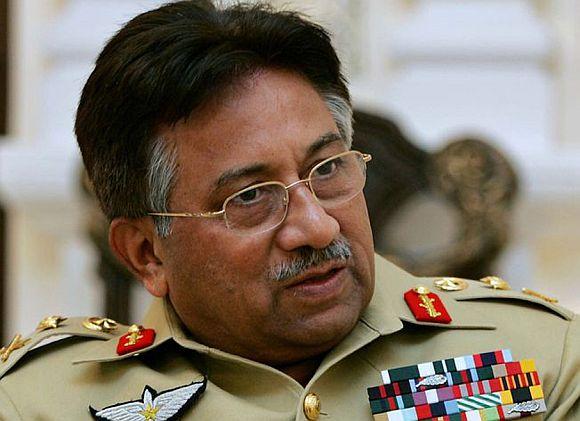
The former officer also accused the then Pakistan Army [ Images ] chief General Pervez Musharraf [ Images ] of a "cover-up".
"There were no mujahideen, only taped wireless messages, which fooled no one. Our soldiers were made to occupy barren ridges, with hand held weapons and ammunition," Lieutenant General Aziz wrote in his article in The Nation.
Headlined, 'Putting our children in line of fire', the Pakistani official, who retired in 2005, wrote, "The whole truth about Kargil is yet to be known. We await the stories of forgotten starved soldiers hiding behind cold desolate rocks, with empty guns still held in their hands. Such precious blood spilled without cause!"
The Pakistani officer said whatever little he knew, took a while to emerge, "since General Musharraf had put a tight lid on Kargil".
"Three years later, a study commenced by GHQ to identify issues of concern at the lowest levels of command, was forcefully stopped by him. ‘What is your intent?' he asked. His cover-up was revealed many years later, on publication of his book," Aziz said.
He said Kargil, an "unsound military plan" based on invalid assumptions, was launched with little preparation and in total disregard to the regional and international environment. It was bound to fail, said Lieutenant General Aziz.
"That may well have been the reason for its secrecy. It was a total disaster," he said and underlined that soldiers were sent as "war fodder".
Pakistan has always maintained that Kargil was fought by mujahideens.
Aziz said that the intrusion was clearly intended to dominate the supply line to Siachen and "force the Indians to pull out".
Aziz wrote, "It certainly wasn't a defensive maneuver. There were no indications of an Indian attack. We didn't pre-empt anything; nothing was on the cards. I was then heading the Analysis Wing of the Inter Services Intelligence and it was my job to know”.
"To say that occupying empty spaces along the Line of Control [ Images ] was not a violation of any agreement and came under the purview of the local commander is astounding. This area was with the Indians as a result of the Shimla Agreement, and there had been no major violation of the Line of Control since 1971," he said.
It was assumed that the Indian Army [ Images ] would not be able to "dislodge us and the world would sit back idly".
"The entire planning and execution was done in a cavalier manner, in total disregard of military convention. In justification, to say that our assessment was not wrong, but there was, 'unreasonably escalated Indian response', is a sorry excuse for not being able to assess the Indian reaction," he said.
He said the “boys” were comforted by their commander's assessment that no serious response would come.
“But it did -- wave after wave, supported by massive air bursting artillery and repeated air attacks. The enemy still couldn't manage to capture the peaks, and instead filled in the valleys. Cut off and forsaken, our posts started collapsing one after the other, though the general publicly denied it," he said.
Lieutenant General Aziz added, "We continue to indulge in bloody enterprises, under the hoax of safeguarding national interest. How many more medals will we put on coffins? How many more songs are we to sing? And how many more martyrs will our silences hide? If there is purpose to war then yes, we shall all go to the battle front. But a war where truth has to be hidden makes one wonder whose interest is it serving?" 

'via Blog this'

Musharraf crossed LoC, spent night in India in 1999 - Rediff.com News

Musharraf crossed LoC, spent night in India in 1999 - Rediff.com News:

Musharraf crossed LoC, spent night in India in 1999

Last updated on: February 1, 2013 15:04 IST
     Next

Next
Weeks before hostilities erupted between Indian and Pakistani troops in the Kargil sector in 1999, Gen Pervez Musharraf crossed the Line of Control in a helicopter and spent a night at a location 11 km inside Indian territory, a former aide to the military ruler has said.
Col (retired) Ashfaq Hussain, who was a senior officer in the Pakistan Army's media arm, said Musharraf flew across the LoC on March 28, 1999 and travelled 11 km into the Indian side.
Musharraf, who was accompanied by Brig Masood Aslam, then commander of 80 Brigade, spent the night at a spot called Zikria Mustaqar, where Pakistani troops commanded by Col Amjad Shabbir were present.
Musharraf, who was then army chief, returned the next day. Hussain first made the revelation in his book 'Witness to Blunder: Kargil Story Unfolds', which was published in late 2008.
He repeated the assertion last night on a television talk show on the Kargil episode in the wake of Lt Gen (retd) Shahid Aziz's assertion that the intrusions by Pakistani troops were planned by a group of four generals led by Musharraf.

'via Blog this'

Wednesday, December 26, 2012

Pakistan: Osama bin Laden paid Rs 50,000 bribe to build his Abbottabad house - Pakistan - IBNLive

Pakistan: Osama bin Laden paid Rs 50,000 bribe to build his Abbottabad house - Pakistan - IBNLive:

Pakistan: Osama bin Laden paid Rs 50,000 bribe to build his Abbottabad house 

PAKISTAN, Updated Dec 26, 2012 at 05:08pm IST
Islamabad: Even the world's most wanted terrorist could not escape the bribery dragnet. Osama bin Laden's safe-house in Pakistan's garrison city Abbottabad was built after paying a bribe of Rs 50,000 to a revenue official, a media report on Wednesday said. The bribe was paid to the 'patwari' so that bin Laden could construct the compound with a three-storey building, a 14-foot boundary wall and an iron fence, the Urdu daily Jang said in a report.
Details of the bribe emerged after Pakistani officials translated a diary that was purportedly kept by bin Laden. Bin Laden, 54, was killed by US commandos during a raid on the compound, located a short distance from the Pakistan Military Academy, on May 2, 2011.
The compound was demolished by the Pakistan Army earlier in 2012. Officials found the diary along with 137,000 documents in the compound. Bin Laden used to write in the diary every day, the report said.
The al-Qaeda chief reportedly described in the diary how he had to bribe revenue officials for constructing his compound. The patwari, who was later arrested by Pakistani security agencies, was completely ignorant about the identity of bin Laden when he took the bribe. The diary reportedly revealed that bin Laden was well aware of the practice of revenue officials seeking bribes and even gave his permission for paying off the patwari.
A judicial commission that investigated bin Laden's presence in Pakistan and the US raid has pointed out "weaknesses" in state institutions in its report and "delineated the poor performance" of these organisations, the Jang reported. The commission's report is yet to be presented to the government and officials have not said whether it will be made public.
(For updates you can share with your friends, follow IBNLive on FacebookTwitter,Google+ and Pinterest)

'via Blog this'

Monday, December 17, 2012

Another suspect arrested in Samjhauta Exp blast case - Rediff.com India News

Another suspect arrested in Samjhauta Exp blast case - Rediff.com India News:

Another suspect arrested in Samjhauta Express blast case

December 17, 2012 20:56 IST


In the second arrest in as many days in the Samjhauta Express blast case, Dhan Singh, a prime suspect, was on Monday arrested by the National Investigation Agency from Madhya Pradesh [ Images ].

 
The arrest came even as the NIA told a Panchkula court that Rajender Chaudhary alias Pehalwan, who allegedly planted a bomb in the Pakistan-bound Samjhauta Express in 2007, played a key role in the entire operation.
Pehalwan, in his mid-30s, was arrested by the National Investigation Agency on Saturday night from Nagda, 50 km from Ujjain, where he was living under an assumed name.
Chaudhary has been sent to 12-day custody of the NIA by the court in Panchkula, near Chandigarh, which is hearing the matter.
Singh, who was arrested from Chitrakoot following intelligence inputs, is also suspected to be involved in the 2008 Malegaon blasts [ Images ] case, sources said in New Delhi [ Images ].
Singh, who is one of the alleged conspirators in the Samjhauta case, was known as 'Swamiji' in Chitrakoot, they said.
It is the fifth arrest in the case. The NIA has already arrested Kamal Chauhan, Aseemanand and Lokesh Sharma for their alleged involvement in the blast.
A huge explosion that ripped through Samjhauta Express near Panipat in Haryana on February 18, 2007 had led to the loss of 68 lives, including women and children.

'via Blog this'

Thursday, November 29, 2012

Karbala and how Lahore was involved | DAWN.COM

Karbala and how Lahore was involved | DAWN.COM:

Karbala and how Lahore was involved

 | 3 days ago
    110
A Muharram procession in Lahore, Pakistan.—File Photo
IN our school and college days we all loved to assist friends set up ‘sabeels’ alongside Lahore`s traditional ‘Ashura’ procession, providing cold drinks to the thousands who mourned. Sects and beliefs never mattered then. But then neither did one`s religion.
For well over 1,332 years, the tragedy of Karbala moves everyone who hears about it, be they Muslim, Christian, Hindu, Sikh or any other religion. This is one incident that brings out the need to support those with a moral position.
As children we attended the ‘sham-i-ghareeban’ with our Shia friends, and learnt the lesson of supporting those in the right. Everyone respected the beliefs of others. Yes, there were always a few silly chaps who wanted attention, but they were at best ignored.
The ancient city of Lahore is connected to the tragedy in no uncertain terms.
Historical accounts say seven brave warriors from Lahore died while fighting in the Battle of Karbala. It is said their father Rahab Dutt, an old man who traded with Arabia in those days, had promised the Holy Prophet (Peace be upon him) to stand by his grandson in his fight to uphold the truth.
That pledge the brave Rajput Mohiyals of the Dutt clan from Lahore upheld.
Today they are known as Hussaini Brahmins, who lived in Lahore till 1947.
Then there is the fact that besides the Hindu Rajputs of Lahore, in the battle also fought John bin Huwai, a freed Christian slave of Abu Dharr al-Ghafari, whose `alleged` descendents, one researcher claims, still live inside the Walled City of Lahore.
I have been on the track of these ancestors for quite some time and have been able to trace one Christian family living inside Mori Gate. They claim to have a connection with a `Sahabi` whose name they cannot recollect. M. A. Karanpikar`s `Islam in Transition`, written over 250 years ago, made this claim, but I do not think it is a claim worth pursuing.
But the most powerful claim of Lahore as the place where the descendents of Hussain ibn All came lies in the Bibi Pak Daman graveyard, where the grave of Ruquiya, sister of Hussain ibn Ali and wife of Muslim ibn Ageel, is said to exist.
Also graves here attributed to the sisters of Muslim ibn Ageel and other family members. Many dispute this claim.
But then no less a person than Ali Hasan of Hajweri, known popularly as Data Sahib, came here every Thursday to offer ‘fateha’ at the grave, informing his followers that this was the grave of Ruquiya. The place where he always stood to offer `fateha` has been marked out, and his book also verifies this claim. Mind you detractors exist, of this have no doubt, but the supporting evidence is quite strong.
Let me begin the story of the Dutts by going through the record of the Shaukat Khanum Hospital and the recorded fact that Indian film star Sunil Dutt, who belonged to Lahore, made a donation to the hospital and recorded the following words: ‘For Lahore, like my elders, I will shed every drop of blood and give any donation asked for, just as my ancestors did when they laid down their lives at Karbala for Hazrat Imam Husain.
Makes you think -but then there is this account which says that the seven sons of Rahab Dutt lost their lives defending the Imam at Karbala. The Martyr’s List at Qum verifies this. History records when the third thrust by Yazid’s forces came, the Dutt brothers refused to let them pass. The seven Punjabi swordsmen stood their ground till they were felled by hundreds of horsemen. In lieu of the loyalty of the Dutt family to that of the Holy Prophet (Peace be upon him) was coined the famous saying: ‘Wah Dutt Sultan, Hindu ka dharm, Musalman ka iman, Adha Hindu adha Musalman.’ Since then, so the belief goes, Muslims were instructed never to try to convert the Dutts to Islam.
A grieving Rahab returned to the land of his ancestors, and after staying in Afghanistan, returned to Lahore. I have tried my very best to locate their ‘mohallah’ inside the Walled City, and my educated guess is that it is Mohallah Maulian inside Lohari Gate. Later they moved to Mochi Gate, and it was there that the famous Dutts lived before 1947 saw them flee from the hate of the people they gave everything for.
The most interesting thing about the Hussaini Brahmins is that they are highly respected among Hindus, and even more amazingly it is said that all direct ancestors of Rahab Dutt are born with a light slash mark on their throat, a sort of symbol of their sacrifice. I was reading a piece by Prof Doonica Dutt of Delhi University who verified this claim and said that all true Dutts belong to Lahore.
I must point out to an amazing version of these events that an Indian historian, Chawala, has come up with. It says that one of the wives of Hazrat Imam Husain, the Persian princess Shahr Banu, was the sister of Chandra Lekha or Mehr Banu, the wife of an Indian king Chandragupta. We know that he ruled over Lahore. When it became clear that Yazid ibn Muawiya was determined to eliminate Hussain ibn Ali, the son of Hussain (named Ali) rushed off a letter to Chandragupta asking for assistance. The Mauriyan king, allegedly, dispatched a large army to Iraq to assist. By the time they arrived, the Tragedy of Karbala had taken place.
In Kufa in Iraq a disciple of Hazrat Imam Husain is said to have arranged for them to stay in a special part of the town, which even today is known by the name of Dair-i-Hindiya or ‘the Indian quarter’ The Hussaini Brahmins believe that in the Kalanki Purana, the last of 18 Puranas, as well as the Atharva Veda, the 4th Veda, refers to Hazrat Imam Husain as the avatar of the Kali Yug, the present age. They believe that the family of the Holy Prophet (Peace be upon him)is Om Murti, the most respected family before the Almighty.
All these facts bring me back to our days as school children working hard to provide relief to the mourners on Ashura. Reminds me of our neighbour Nawab Raza Ali Qizilbash, who invited us to his ‘haveli’ every year to see the preparations before the event. Raza Bhai is no more, and neither is the tolerance that we all enjoyed so much.

'via Blog this'

Tuesday, November 20, 2012

The Ideology of Pakistan: A thorny issue | DAWN.COM

The Ideology of Pakistan: A thorny issue | DAWN.COM:

The Ideology of Pakistan: A thorny issue

 | 6th November, 2012
    237

-Illustration by Khuda Bux Abro
If I were a rational person I would not be writing this blog. In the past I have lamented the proliferation of garbage, lauded junkies and soothsayers at a sufi saint’s shrine, delved into nostalgia about rail travel, and written about other harmless subjects.  These blogs and features received mostly bouquets and some brickbats from the readers.
But today I want to talk about a very difficult subject. No, I am not confessing that I am a serial killer or a closet drag queen; sorry, nothing juicy like that. This particular subject has been like a thorn in my heart for many years but good judgment and sane counsels from friends has stopped me from pulling it out of my heart and speak out what I really think about it. Pakistan’s poet laureate Faiz Ahmed Faiz perfectly expressed this feeling thus:
Harf-e-haq dil mein khatakta hey jo kantey ki tarha
Aaj izhar karein aur khalish mi tjaey
(The truth that lives in the heart like a thorn)
(Speak it out, now, and banish the pain)
You see, I have a serious problem with the question, “What is the ideology of Pakistan?” I can see you, dear reader, sniggering and saying, “Every man, woman, transvestite, child, the 25 per cent literate or the 75 per cent illiterate, and even some intelligent well brought up parrots know that there is a single word answer to this question, and it is Islam. Even the country’s full name is “The Islamic Republic of Pakistan” and according to the constitution, “only a Muslim can become the head of the state”.
So case closed; get back to writing about garbage dumps because that is where you rightly belong.
I think dear reader, you are right and I should stop here. But, what to do about the thorny medical condition that Faiz Ahmad Faiz has talked about in his verse?  No, I cannot stop; I belong to the Faiz tribe and must banish this pain, now.
You see, all manner of thinkers, whether liberal (simple, leftist or Islamist flavour), or radical (again of the three flavours) or secular, and any valid combination thereof have me totally confused.
The simple liberals say: Pakistan was created for the Muslims who could not possibly thrive in a Hindu dominated India. Hindus and Muslims are two different nations. Thus, the ideology of Pakistan is Islam.  They quote Quaid-i-Azam’s speeches to support their point of view.
I humbly submit the following questions and opinions to this august group:
1.    What about the large number of Muslims that were left behind in India? If the larger Muslim populace could not survive under the domination of the powerful Hindus what chances did the much-diminished population of Muslims have? Imagine, if today all the Muslims were in an undivided India they would have constituted nearly 40 per cent of the total population! That would have given them serious political clout to fight for their rights.
2.    Consider that by creating a new state based on distrust and hatred, it actually created two warring states on day one of their creation. This intense animosity between the two countries has remained the single most important factor in the formulation of Pakistan’s foreign policy. Internally, every leader in Pakistan has cynically invoked the specter of the fear of India and milked the cow of national security whenever faced with domestic unrest and disaffection. The distrust of India gives immense clout to the army that gets a free hand to spend the poor country’s money on defense. What has that expenditure given in return? Half the country was lost and the remaining is living under very insecure conditions. Soon there may be nothing left to defend!
3.    What happened as early as 1971 to that great common bond of religion that was the basis of creating a new nation? Just 24 years after the creation of the Islamic Republic of Pakistan more than half the population decided they had enough of being part of the great Republic?
4.    Following the partition of India in 1947, Mohammad Rushdi’s lovely voice sang to us on the radio;
Hum laayen hein toofan sey kashti nikal key
Iss mulk ko rakhna meray bachoo sumbhal key
(We have steered this boat through stormy waters)
(My children, take care of your precious country)
And stormy waters they were; millions killed, maimed, raped and displaced on both sides. A human tragedy occurred on a colossal scale that was not anticipated by any of the great leaders of the Hindus, Muslims or British. Who should history hold responsible for these massacres?
The same saga was repeated in 1971. Once again, thousands killed, raped or maimed. Only this time it was the blood of Muslims mingling with the blood of other Muslims and the semen of Muslim Pakistani soldiers entering bodies of Muslim Bengali women. No Sir, this does not fit well at all in your raison d’ĂȘtrefor Pakistan, the famous “Two Nation Theory”. Where was the mother of all bonding, “Islam”? Unless, of course, you say that East Pakistan and West Pakistan were two nations in this case! More likely, years of exploitation by the West Wing gave the Bengalis a broken heart that no bond could keep together and no balm could heal.
“To hell with the short, dark, cowardly Bengalis, they were a burden on our economy anyway. Good riddance!”
Sir, I cannot argue with this impeccable logic based on sound military and economic theory.
5.    But the thorn is still residing in my heart and it is asking you, “Do you realise that the Bengalis are doing far better now in Bangladesh than they were in Pakistan? And the good Muslims, the Biharis (labeled Bhikaris or beggars by our great erstwhile Amir-ul-Momineen, Gen. Zia-ul-Haq) who supported a united Pakistan are still rotting away in the infamous “Geneva Camp”, homeless and stateless. And I guess it is relevant to remind you that you left a lot of Muslims back in India in 1947 too! Who is next on the list of your “Jamaican Farewell”?
6.    Fast forward from 1971 to now. The country is splitting apart like a rag doll.  The glue of Islam has come unstuck. It is not the infernal enemy India that has caused this. We are our own worst enemy.  The Balochis are demanding a separate province. Parts of Pakistan are not in the control of the state. The demand for an autonomous Sindh is picking up steam. How do you explain this?  All these people demanding independence are Muslims, not a Hindu or Sikh is to be seen. Reminds me of the famous poem about the five mice that set out to hunt and only one came back alive! I think you can guess who the last mouse left in the Islamic Republic is.
The secular / left-liberals claim that Pakistan was envisioned as a secular state. This group, ad nauseam, quotes M.A. Jinnah’s 11thAugust, 1947 speech that talks of equal rights for all religious groups in the newly formed Pakistan.
I pose the following questions to these well-meaning idealists:
1.    Respected Sirs, if Mr. Jinnah had envisioned Pakistan as a secular state why did he bother to create it in the first place? Pre-partition India was secular and remains secular to this day.
2.    If Pakistan was to be a secular state why do religious groups wield so much clout that even a so-called liberal, Mr. Bhutto, bowed down to their demand for banning alcohol (that he imbibed with a gusto himself) and declaring Ahmadis as non-Muslims? It is clear that the religious extremists have far greater power than their performance at the polls suggests. Acts of violence against minorities continue unabated. Draconian laws created by Zia-ul-Haq continue to thrive and no one dare repeal them.
Lastly, the Religious groups claim that Pakistan was created to be a “true” Islamic state where every aspect of life and death will be according to the tenets of Islam.
To this fine group of Islamic scholars and fighters, I ask how did they determine that “true” Islam forbids modern education, imposes severe restrictions on women, instructs elimination of non-Muslims or bans a good game like football?
I will not insist on an answer since it is most likely written on the tip of a bullet.
So now I am in a situation that the great Caribbean crooner Harry Belafonte found himself in when he asked his father to tell him about the birds and the bees:
It was clear as mud, but it covered the ground
And the confusion made my head go around
Therefore, friends, liberals/leftist/rightist/centrists, I am going to give my answer: get ready to swallow the bitter pill.
The Muslim extremists are morally right! The ideology of Pakistan is Islam (remember, everyone is Pakistan knows that). The creation of Pakistan gave the perfect weapon to the likes of TTP and LeT. A weapon that was more powerful than any nuclear device. They got a complete country called Pakistan, beautifully packaged in green, with a big card on it that said, “Made for Islam”. You can argue till the cows come home that the brand of Islam of the TTP is not the “Real Islam”. If theirs is not the real Islam can anyone present an alternative model of an Islamic state? Saudi Arabia? Afghanistan under the Taliban? Iran? (Sorry, these guys are Shias, thus non-Muslims). Mr. Bhutto tried to sell “Islamic Socialism”; he was hanged. Poor Mr. Salman Taseer just mentioned his dislike for the blasphemy law; he was killed and the killer was garlanded by no less than our lawyers.
No one can come up with such a model for the simple reason that a theocratic state cannot work in modern times.
I have no cure to offer. We cannot turn back the clock to 1947.  However there are three minimum prerequisites for making a new start:
1. We must have the moral courage to privately and publicly declare that religion cannot be the basis for creating a nation-state. Once we have established this basic premise we do not let anyone – whether an elected representative or a religious extremist – use religion to exploit those honest, hardworking Pakistanis who are only seeking a square meal, some security of life and property, a decent education, healthcare and a little hope for the future.
2. We must insist that religion is a matter of one’s belief and faith and there can be no restriction on practicing it in the private realm, but that we must separate it from the affairs of the state.
3. We normalize our relationship with India and shift our priority from defense to regional cooperation.  Internally, we divert our resources from national security to the social sector.
But I am afraid that none of the above will happen and we are more likely to hang the messenger.
Faiz Sahib, the thorn is out and the pain is gone and now as you said:
Ik mout ka dhanda baqi hey, uskko bhi hum nipta leingey.
(All that is now left is the business of death, and that too will be taken care of soon).


'via Blog this'